
Portrait of Dante, by Sandro Botticelli
Dante’s Comedy is a journey into other worlds. We are taken to the realms of that which is hidden. It is our suffering folded out from within, and in vital contrast that shine and beckon to us. It is terror and the opposite. Of the Comedy’s three parts, the first – Inferno – most easily captures the imagination. Yet it is not just the ruins of ‘the hell of our lives’ that are exposed to us; they can never exist alone. It is the journey through the nightmare, and ultimately the way out. When I first began reading Dante, I wondered how many people really read this work or any of its many translations. The answer I believe is very few at all, and this is one of the main reasons for thecomedyproject – to make the world of the Comedy available to ordinary people today, 700 years on in in time from when Dante finished his writing.
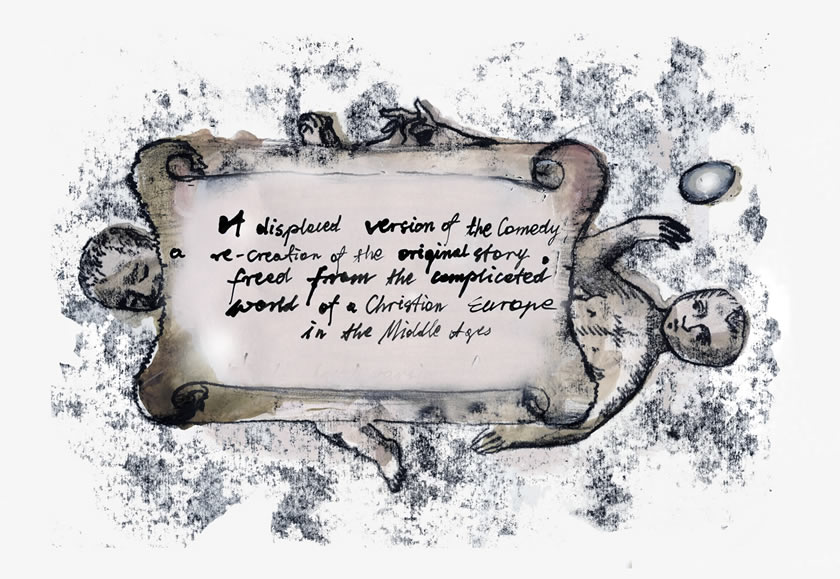
If you are looking for an English translation of Dante’s Comedy, this is not the place to be. The idea behind this project is to present a displaced version of the Comedy, a re-creation of the original story, freed from the complicated world of a Christian Europe in the Middle Ages. The original work is full of references to all sorts of people and institutions in Florence, Tuscany, Rome, and the waring states of France and Germany. If thecomedyproject leads you to read the original, that is brilliant, but it is not the reason for the project. My goal is to make the world Dante saw accessible – to a broader range of people – who are not necessarily ‘into literature’ but are looking for a good story and human insight. In the process of doing this I have put aside much of the detail and formal structure of the original. Hence – a displaced version.

Dorothy Sayers’ translation
Detective story writer Dorothy Sayers’ translation of the Comedy from the mid twentieth century was my way into Dante. This version has been criticised, but I still feel after reading many other translations, that Sayers’ approach, her comments and thoughts are so often like a breath of fresh air. The Oxford version by C.H. Sisson is in contrast more pedantically correct, but in being so sheds light on many of the linguistic aspects of the work. Then there is the Oxford edition by Robert M. Durling which runs parallel page for page with the original Italian, and provides that direct comparison of words and expressions that can be so fascinating and entertaining.

Dante’s Purgatory – Valley of Rulers by William Blake
Living in Norway, and speaking Norwegian has also meant that Trond Berg Eriksen’s «Reisen gjennom helvete», (Journey through Hell) a thorough analysis of the Inferno, has also been most useful. Illustrations – by Botticelli, William Blake, Gustave Doré and Salvador Dali – have also provided great inspiration.
Many people ask me why I have chosen to publish the ‘work so far’ on the web. The answer is – it is simply so immediate. People all over the world can see a work in progress – comment, discuss and participate. I hope that as many people as possible will give feedback and ideas, and possibly suggest changes which can so easily be made – to a work that has not yet appeared in print.
The focus of the project has all the time been the individual songs of the Comedy. But at one point, I think it must have been around 2010, I had a strong need to get away from myself and discuss the work with other people. However, there were very few people I felt I could talk to. I contacted publisher but to no avail, and I seriously considered letting the whole project lie. Around about this time I had a number of discussions with my son, William. Gradually he understood where I was trying to go with all this and suggest a form of presentation that could make it readily available to the general public. From this the idea of an initial web publication was born.
I have always been attracted to writing combined with a visual dimension. Text page after text page of thecomedyproject called for an artist’s hand. One day William spoke to me about a Polish artist that he had got to know, Monika Konieczna. She had an impressive portfolio of artwork, mime and performance. He also told me about some of her interpretations of Edvard Munch’s paintings she had done when she was still quite young. I contacted her and immediately recognised that here was the potential for an exciting collaboration.
At our initial meeting in Litteraturhuset in Oslo we discussed how a writer and an artist could work together on thecomedyproject, and at the same time retain our individual integrity. In other words not planned illustrations, but an artist freely interpreting the songs. Monika, with her Catholic upbringing and having been a student at the academy of fine arts in Wroclaw in Poland, had an immediate ability to go into this visionary world. She appeared at our next meetings with sketches that were unique and inspiring. She went on to develop these into the illustrations that you see here.
This publication follows Dante’s pattern: first the Inferno’s 34 songs, then Purgatory’s 33, and
finally the 33 of Paradise. I call them songs, as Dante called them cantos, although chapters might be a better word.
 The Comedy Project